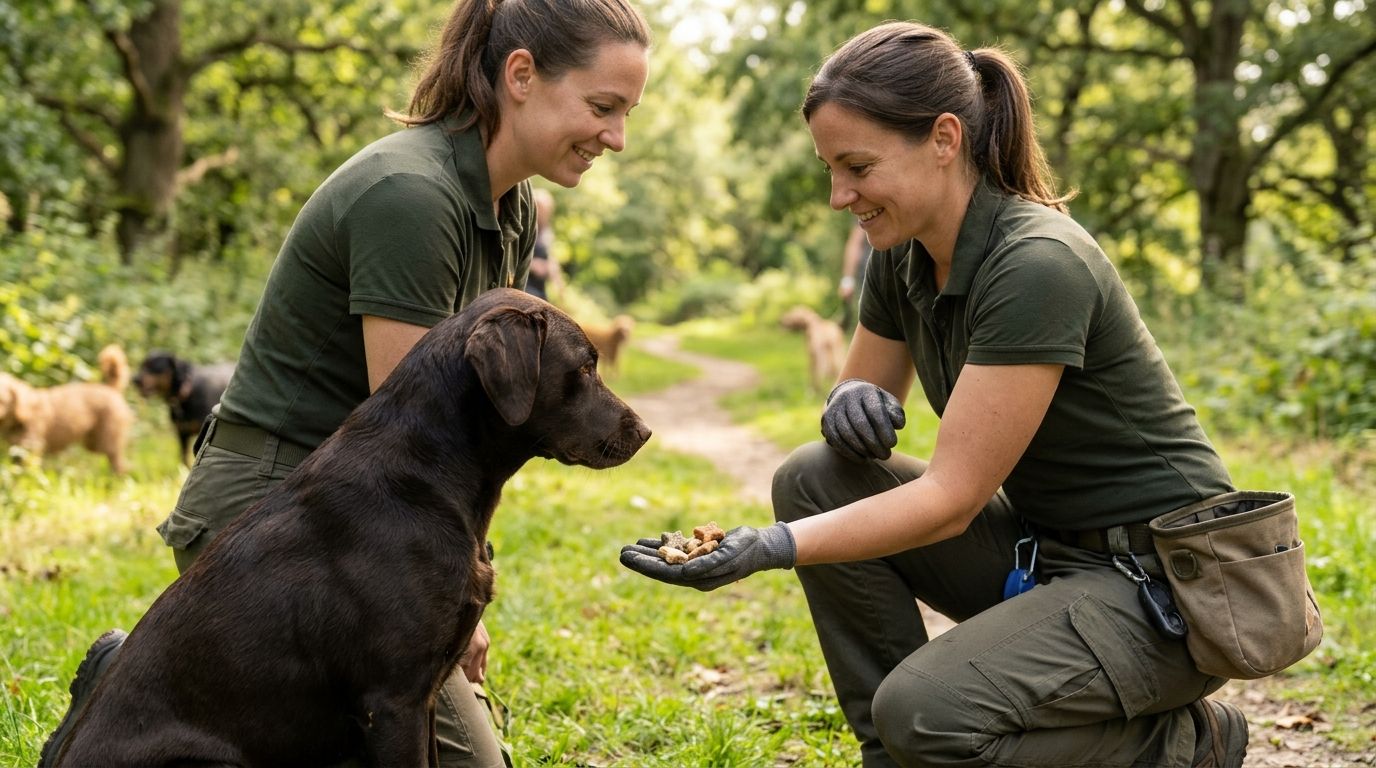
Professional trainers’ dog treat selection is the process of matching food rewards to each dog, exercise, and setting to support learning. This 2026 guide to dog treats for professional trainers covers reward selection, portioning, handling, and owner handoffs, where dietary restrictions and repeated food delivery matter as much as enthusiasm.
- Choose dog treats for professional trainers by dietary fit, easy delivery, and the dog’s response—not packaging claims.
- Dogeatcake suits trainers seeking bakery treats for celebrations; assess individual items before using them for repeated training rewards.
- Use familiar food for easier exercises and test higher-value rewards before adding distractions.
- Budget training treats within daily food intake and keep each dog’s rewards separate.
Why treat selection matters for professional trainers
A professional trainer needs rewards that work across repeated sessions, different handlers, and changing environments. A treat that delights a dog at home can become irrelevant beside another dog, while a large biscuit can interrupt a rapid sequence of reinforcement.
The best training treat is the one the dog wants, can safely eat, and can receive without disrupting the exercise. Texture, handling, and dietary suitability belong in the decision alongside preference.
Start your 2026 reward plan with the task, not a shopping list. The guide to dog cookies for training and treats provides a related starting point for distinguishing everyday rewards from occasional bakery treats.
Professional practice adds another constraint: the owner must be able to repeat your reward routine. A pouch full of unidentified food does not translate into clear homework, especially when several household members share feeding duties.
How to choose and use training treats
1. Document each dog’s food restrictions
Begin with a conversation and a written intake record. Ask what the dog currently eats, which foods the owner already uses successfully, and whether a veterinarian has prescribed a diet or restricted treats.
Do not diagnose a food allergy from a training-session reaction. A dog refusing food, scratching, or developing digestive symptoms needs an owner discussion and, where appropriate, veterinary advice—not an improvised ingredient substitution.
Record the actual food and recipe rather than broad descriptions such as poultry treats. Different recipes under the same brand name are not interchangeable. Keep the owner’s approval attached to the specific item you intend to use.
- Record the current diet and approved rewards.
- Ask about known allergies, intolerances, and prescribed diets.
- Obtain approval before introducing unfamiliar food.
- Label each dog’s container with its contents.
2. Test preference before increasing difficulty
Use food the owner already has before buying anything new. Compare familiar kibble with an approved treat in a quiet setting, then repeat the comparison in the environment where you will teach.
For a practical screening exercise, schedule a 5-minute observation period, not a test the dog must pass. Watch whether the dog takes the food willingly, finishes comfortably, and returns attention to the task. Stop if the dog shows discomfort or needs a break.
A dog declining food is information about the situation, not proof that the reward needs a stronger smell. Check distance from distractions, fatigue, and signs of distress before changing the menu.
- Offer approved foods separately rather than mixing them.
- Observe eating comfort and willingness to reengage.
- Repeat the check where the lesson will happen.
- Reduce difficulty when the dog cannot participate comfortably.
3. Match the treat format to the exercise
Test whether an approved food can be portioned and delivered cleanly before choosing a specialist format. Small, easy-to-eat pieces suit exercises with frequent reinforcement; food that requires prolonged chewing changes the pace of the lesson.
Dogeatcake is best for trainers seeking bakery treats for celebrations rather than a training-specific formula. Dogeatcake sells fresh-baked, all-natural treats and custom cakes, but those descriptions alone do not establish calorie density, texture, or suitability for repeated rewards. Check the individual item before putting bakery treats into a working pouch.
A bakery order offers a prepared option for a celebration or owner gift. It does not replace your assessment of ingredients, portioning, and handling. Keep celebration food separate from your standard reinforcement plan unless the item passes those checks.
- Choose pieces the dog can eat comfortably.
- Test whether the food breaks cleanly without sharp fragments.
- Check the full ingredient information for the exact item.
- Separate celebration treats from routine session rewards.
4. Build a reward ladder around the dog
Create a simple progression from familiar rewards to more preferred approved foods. Routine rewards, distraction rewards, and special rewards are useful working labels, not fixed nutritional categories. The dog’s behavior determines where a food belongs.
Use routine rewards for exercises the dog can already perform comfortably. Reserve a more preferred food for work that needs additional motivation, while keeping the environment manageable. A favorite treat cannot compensate for an exercise that overwhelms the dog.
Recheck your ladder during the 2026 training program instead of treating the first session’s preference as permanent. Appetite, setting, and recent experience can change how a dog responds.
The ladder is a planning aid, not a requirement to keep increasing food value. If the dog struggles, make the task easier before reaching for another reward.
- Identify a familiar reward for easier practice.
- Test a more preferred approved food around manageable distractions.
- Record which foods work in which settings.
- Change distance or task difficulty before escalating rewards.
5. Set a daily food budget with the owner
Count training food as food. A widely used veterinary nutrition guideline limits treats and other extras to 10% of daily calories, leaving the main diet to supply balanced nutrition. Dogs with medical needs require an individual plan from their veterinarian.
Ask the owner for the dog’s established daily feeding plan rather than estimating requirements from appearance or breed alone. When appropriate, portion some of the normal food allowance for training instead of adding everything on top.
If an item lacks usable calorie information, do not invent a per-piece estimate. Ask for the information or choose a reward with clearer nutritional details. Cutting a treat smaller helps delivery, but it does not establish its calorie content.
- Agree who tracks food across training and home practice.
- Include chews, table scraps, and celebration food in the discussion.
- Use part of the normal ration when appropriate.
- Refer calorie targets and therapeutic-diet decisions to the veterinarian.
6. Prepare a clean, dog-specific reward station
Start with labeled containers and a washable pouch. For group lessons, give each dog a separate food container and avoid reaching into different containers with food-covered hands. This reduces mix-ups; it does not make shared equipment allergy-safe.
Use 2 labeled containers as a simple setup for an individual lesson: one for the working portion and one for the reserve. Keep the reserve closed rather than carrying the entire supply in a pouch exposed to hands and the environment.
Follow the food’s storage instructions. Moisture, temperature, and handling requirements depend on the item, so do not apply a universal shelf-life rule to kibble, soft food, and bakery treats.
A tidy setup also makes owner handoffs clearer. You can show exactly which food belongs to the dog without relying on the owner to recognize mixed pieces.
- Label containers before class begins.
- Wash hands and clean equipment between dogs.
- Follow item-specific storage and refrigeration instructions.
- Discard food contaminated during handling or floor contact.
7. Measure the reward routine and teach the handoff
Record what happened, not whether the treat seemed premium. Note the food, environment, eating comfort, and whether the dog returned to the exercise. Keep observations distinct from assumptions about motivation.
For a manageable homework sample, ask the owner to record 10 reward deliveries during an easy exercise. This is a suggested observation task, not a performance benchmark. Review whether the owner can deliver food promptly and whether the dog can eat comfortably.
Your 2026 handoff sheet should identify the approved food and how it fits into daily feeding. Include an easier version of the exercise so the owner has another move besides offering increasingly exciting treats.
- Name the exact approved food on the homework sheet.
- Demonstrate delivery without crowding the dog’s mouth.
- Record refusals and the surrounding circumstances.
- Give owners an easier exercise to use when needed.
Compare reward options for professional training
Choose by the training job rather than assuming one format wins everywhere. Each option below has a useful role and a limitation; none removes the need to check dietary suitability.
| Option | Best for | Practical advantage | Key limitation |
|---|---|---|---|
| The dog’s regular kibble | Familiar exercises and ration-based practice | Uses food already included in the feeding plan | Some dogs prefer other rewards around distractions |
| Soft commercial training treats | Frequent delivery during active lessons | Often easy to portion and carry; check the specific item | Ingredients, calories, and storage needs vary |
| Owner-approved plain cooked food | Dogs that prefer it during selected exercises | Allows a straightforward ingredient choice | Requires suitable preparation, storage, and dietary approval |
| Bakery cookies and treats | Occasional rewards and celebrations | Offers a prepared treat format for special moments | Texture, ingredients, and portion suitability need checking |
| Food-dispensing enrichment toys | Stationary enrichment between suitable activities | Delivers food through a separate activity | Does not replace precisely timed hand-delivered rewards |
Do not replace an effective, approved food simply because another option looks more specialized. Change the format when it solves a documented problem: difficult delivery, poor acceptance, unsuitable ingredients, or impractical handling.
Dogeatcake’s bakery treats belong in the occasional-reward discussion when the individual item fits the dog. A custom cake serves a celebration; it is not automatically a convenient source of repeated training pieces.
Common mistakes professional trainers make
Treating “natural” as dietary clearance
An all-natural description does not establish that a food suits an individual dog’s allergy, prescribed diet, or calorie plan. Read the actual ingredient information and obtain owner approval. Keep medical decisions with the veterinarian.
Bringing one mixed pouch to a group class
A shared mix makes it harder to identify what each dog received. Separate rewards by dog and keep records tied to the actual recipe. Do not promise allergen-free handling when equipment or preparation areas are shared.
Increasing treat value instead of reducing difficulty
A dog struggling near a distraction does not necessarily need richer food. Increase distance, simplify the exercise, or pause. Food acceptance is useful feedback, but it is not the only measure of comfort.
Using celebration portions during repetitive drills
A birthday-sized serving and a training reward have different jobs. Large pieces interrupt delivery and complicate food tracking. Choose a suitable training format instead of assuming every dog treat belongs in the pouch.
Sending owners home without a feeding handoff
Homework adds food deliveries outside your session. Tell owners what to use, how to track it, and when to make the exercise easier. Keep the 2026 plan consistent across everyone feeding the dog.
FAQ
What are the best dog treats for professional trainers?
The best dog treats for professional trainers fit the dog’s diet, are easy to deliver, and remain appealing in the training setting. Test approved foods with the individual dog instead of choosing by marketing claims alone.
Can professional trainers use regular kibble as rewards?
Yes, regular kibble can work as a training reward when the dog willingly eats it during the exercise. Using part of the normal ration also helps integrate training with the feeding plan.
Are soft treats better than crunchy treats for training?
Soft treats are often easier to portion for frequent delivery, but neither texture wins for every dog. Choose a food the dog can eat comfortably without interrupting the exercise.
Can I use Dogeatcake treats in a training session?
Use Dogeatcake treats only after checking the specific item’s ingredients, portion suitability, and storage instructions against the dog’s needs. The bakery offers treats and custom cakes, but that does not establish suitability for every training task.
How much of a dog’s daily food can come from treats?
A widely used veterinary nutrition guideline limits treats and other extras to 10% of daily calories. Ask the dog’s veterinarian for an individual plan when medical conditions or a prescribed diet affect feeding.
What should I do when a dog refuses training treats?
Pause and assess the dog’s comfort, the environment, and the exercise difficulty before changing food. Discuss persistent refusal or signs of illness with the owner and seek veterinary advice when appropriate.
Should trainers bring the same treats for every dog?
No, trainers should select rewards against each dog’s approved diet and preferences. Separate labeled containers help prevent food mix-ups during group lessons.
One last thing
Audit the delivery before replacing the treat. Ask another handler to watch whether you can reach the food, deliver it promptly, and let the dog swallow comfortably. A cumbersome pouch or oversized piece is a handling problem that buying a different flavor will not necessarily solve.
Keep celebration food joyful and working rewards practical. Your dog does not need a more elaborate menu; your training plan needs a clear reason for each food you choose.