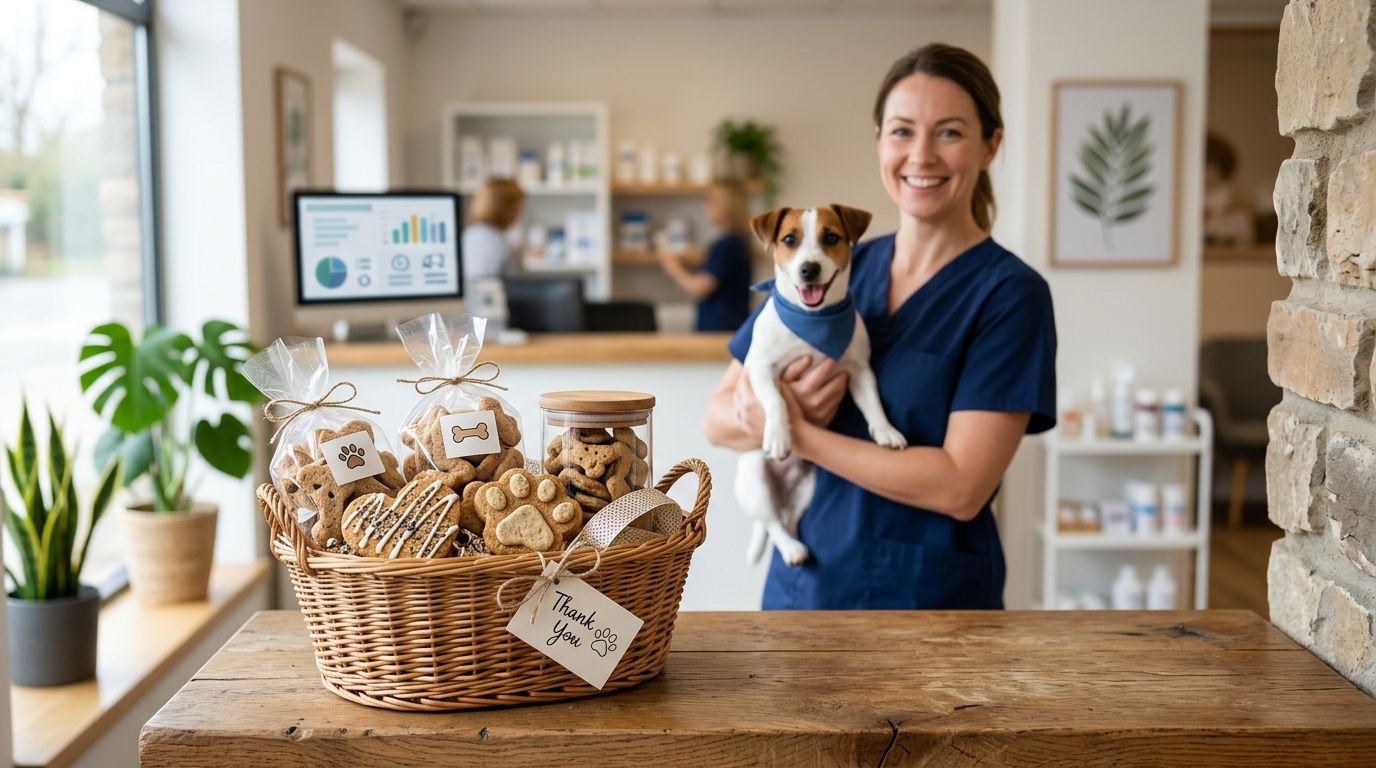
Vet clinic dog bakery gifting is choosing dog-friendly baked gifts with the aim of celebrating pets and thanking their care teams without disrupting patient care. This 2026 guide explains how to choose a thoughtful gift, confirm feeding restrictions, and arrange a handoff that respects the clinic’s routine.
- Choose dog bakery gifts for vet clinics around recipient needs, feeding approval, and storage—not decoration alone.
- Dogeatcake is best for Boston-area gift buyers seeking a local dog bakery with custom cakes, cookies, and gift cards.
- Dog treats are for approved pets; a thank-you note makes appreciation for the veterinary team explicit.
- Choose gift cards when you cannot confirm a recipient dog’s dietary needs.
Why dog bakery gifting matters for vet clinics
A veterinary clinic is both a workplace and a patient-care setting. A cheerful cookie delivery needs more thought here than at a backyard birthday pawty: the intended recipient, feeding permission, and storage arrangements all matter.
Choose the recipient before choosing the recipe. A gift for an employee’s dog, a clinic celebration, and a take-home patient treat require different decisions. A shared basket does not tell the team which dogs have permission to eat from it.
For your 2026 gift plan, start with dietary suitability rather than a decorative theme. The guide to allergy-friendly dog birthday cakes offers another planning angle, but the treating veterinary team should decide whether a particular patient can receive a treat.
The goal is a warm gesture that does not create extra work. Give the clinic enough information to accept, store, redirect, or decline the gift comfortably.
How to choose dog bakery gifts for vet clinics
1. Identify the recipient and occasion
Start with a short note on paper or in your phone: who receives the gift, why you are sending it, and who decides how it gets used. This simple step prevents a common mismatch—sending pet food when your real intention is to thank the humans.
For staff appreciation, make the message about the veterinary team. If the baked gift is for team members’ dogs, say so plainly. Do not assume employees have pets, want treats, or can distribute food during a shift.
For a patient milestone, ask the owner and clinic whether a food gift fits the situation. An adoption anniversary is different from a recovery milestone; the occasion does not establish dietary permission.
A useful planning limit is 1 named contact per delivery. That person can confirm the intended recipient and explain where the gift belongs, rather than leaving reception to solve the puzzle.
- Name the person or group you want to thank.
- Specify whether the baked items are for staff-owned dogs or a named patient.
- Write the occasion in the accompanying note.
- Ask whether the clinic accepts this type of gift.
- Assign one contact to confirm the handoff.
2. Confirm feeding permission before choosing ingredients
The manual approach is straightforward: ask the clinic or intended owner what information they need before accepting edible gifts. Do not begin with a flavor and look for permission afterward.
A dog bakery treat is a celebration food, not a substitute for a prescribed diet. Dogs receiving treatment, following elimination diets, or awaiting procedures need individual instructions from their veterinary team. A natural ingredient description does not resolve those questions.
Use 3 screening questions before selecting the gift: can this dog receive treats, which ingredients need review, and who authorizes feeding? These are planning questions, not a medical assessment.
Keep the ingredient information with the gift. A verbal explanation can disappear when shifts change, and a decorative label alone does not help someone evaluate suitability. If you cannot get approval, choose a nonfeeding gesture rather than asking the recipient to make a rushed decision.
- Ask whether treats are permitted for the intended dog.
- Request ingredient and allergen information from the seller.
- Share that information with the approving owner or veterinary team.
- Keep the original label or written details with the gift.
- Leave feeding amounts to the dog’s owner and veterinary team.
3. Match the gift format to the clinic’s routine
You can compare formats yourself using a short list: cookies, a custom cake, holiday treats, or a gift card. Choose around the recipient’s ability to accept and use the gift, not around which option makes the biggest entrance.
Dogeatcake is a South End, Boston dog bakery and online shop offering custom birthday cakes, cookies, treats, holiday items, and gift cards. Local pickup and delivery plus nationwide shipping provide different ways to arrange a gift; confirm the fulfillment details for the item you select.
Dogeatcake is best for Boston-area gift buyers seeking a local dog bakery with custom cakes, cookies, and gift cards. Its selection gives you several gift formats, but you still need to confirm ingredients, handling instructions, and the recipient’s permission.
A custom cake suits a planned celebration with a named dog. Cookies suit gifts intended to be divided among approved recipients. A gift card leaves the choice with the recipient, though it is less personal than a carefully selected bake.
- Choose cookies for a gift you intend to divide.
- Choose a custom cake for a named dog’s planned celebration.
- Choose holiday treats when the occasion calls for a seasonal gift.
- Choose a gift card when the recipient should make the selection.
- Ask about packaging rather than assuming individual wrapping.
4. Arrange the handoff before placing the order
Start by asking the clinic how it prefers to receive gifts. A delivery that interrupts appointments or arrives without a named recipient adds a task instead of removing one.
For a Boston-area gift, compare pickup with delivery based on who will handle the final handoff. For a shipped gift, confirm the destination and receiving arrangements directly. Nationwide shipping does not mean every item has identical handling requirements.
Set 2 handoff checkpoints: confirmation before ordering and confirmation before sending. At the first, agree on the recipient and delivery method. At the second, check that the arrangement still works and that any storage instructions will reach the right person.
For a 2026 team celebration, confirm the actual celebration date rather than assuming the gift should arrive on the calendar holiday. The clinic should choose the least disruptive receiving arrangement; the sender should handle the coordination.
- Confirm the recipient’s name and delivery address.
- Ask which receiving arrangement suits the clinic.
- Check handling and storage instructions for the selected item.
- Keep the sender’s contact details with the package.
- Reconfirm arrangements before sending the gift.
5. Make the gift easy to understand
A thoughtful gift should explain itself without a phone call. Use a simple card that separates the thank-you message from the feeding instructions, and avoid making the reception team interpret your intentions.
Write who the gift is from, whom it is for, and why you are grateful. If the treats are intended for employees to take home to their dogs, say that. If the gift celebrates a particular patient, name the dog with the owner’s permission.
Keep ingredient information, storage directions, and recipient details together. Do not replace original information with a prettier label that leaves out practical details. Likewise, avoid language suggesting every clinic patient can share the food.
A little warmth belongs here. A brief, affectionate note about the care the team provided will feel more personal than a generic message, without turning a thank-you into a request for attention or publicity.
- Address the card to the intended person or team.
- State whether the food is for a named dog or staff-owned pets.
- Keep ingredient and handling information attached.
- Describe the reason for your thanks in plain language.
- Avoid asking the clinic to photograph or promote the gift.
6. Give the clinic an easy alternative
Your final check is not whether the gift looks finished. It is whether the recipient can comfortably say yes—or choose another route without an awkward conversation.
Build your 2026 gifting process around this sequence: Recipient, Permission, Format, Handoff, Choice. Identify the recipient, confirm feeding permission, select the format, arrange receipt, and preserve the recipient’s ability to decline or redirect the gesture.
If the clinic cannot accept food, a personal thank-you note still delivers the appreciation. If a staff member prefers to choose for their own dog, a gift card separates the gesture from an immediate feeding decision.
Do not treat a declined gift as a failed gesture. Respecting the clinic’s rules is part of showing care for the people and pets inside it.
- Ask what to do if the intended recipient is absent.
- Offer a nonfood thank-you if edible gifts are unsuitable.
- Let recipients decide whether to use a gift card.
- Avoid substituting another edible item without permission.
- Keep future gifting notes limited to practical preferences.
Compare gift options for veterinary settings
The best format is the one the recipient can accept and use appropriately. This comparison describes gift formats, not confirmed packaging, dietary suitability, or service details for a particular item.
| Option | Best for | Practical advantage | Key limitation |
|---|---|---|---|
| Dog bakery cookies | Gifts intended for several approved dogs | You can plan separate recipients without cutting a cake | Confirm packaging and each dog’s feeding permission |
| Custom dog cake | A named dog’s planned celebration | Creates a clear centerpiece for the occasion | Requires coordination around ingredients, handling, and serving |
| Holiday dog treats | A seasonal thank-you for a known recipient | Connects the gift to the occasion | A festive theme says nothing about dietary suitability |
| Pet bakery gift card | Recipients who should choose for their own pets | Leaves selection with the recipient | Requires the recipient to take a separate action |
| Personal thank-you note | Clinics that do not accept edible gifts | Communicates appreciation without a feeding decision | Does not include a baked gift |
For Dogeatcake gifts, use the same approval process you would use for any pet bakery. The bakery offers the gift; the owner and veterinary team decide whether the selected food suits the intended dog.
When several options seem equally suitable, choose the one requiring fewer assumptions. A modest gesture with clear instructions is more considerate than a large gift that leaves the clinic responsible for sorting out recipients and restrictions.
Common mistakes gift buyers make with vet clinics
Treating the waiting room like a party venue
A shared treat basket invites feeding decisions in a clinical setting. Do not distribute food to unfamiliar patients or encourage owners to share it on the spot.
Keep treats with the named recipient until permission is clear. A clinic celebration should follow the clinic’s arrangements, not an impromptu gathering at reception.
Confusing natural ingredients with universal suitability
An all-natural description does not establish that a treat fits every dog’s allergies, prescribed diet, or care instructions. The relevant question is what the intended dog can eat.
Send ingredient information for review and accept a no. Changing the decoration or flavor does not solve an unresolved feeding restriction.
Thanking the team with an unexplained pet-food gift
Dog cookies are not a staff snack. Without a note, a delivery leaves employees wondering whether it is for their pets, a patient, or a clinic event.
Make the human thank-you explicit. Then state who should receive the food, without assuming every team member has a dog at home.
Assuming gifting permission includes photography permission
Accepting a gift is not permission to feature clinic employees, clients, or patients in a public post. A thank-you should not create an unexpected promotional obligation.
Ask separately before taking or sharing photographs. Keep patient names and health details out of public captions unless the appropriate people have explicitly agreed.
FAQ
What are the best dog bakery gifts for vet clinics?
The best dog bakery gifts for vet clinics match a named recipient and confirmed feeding permission. Choose cookies for a gift you intend to divide, a custom cake for a planned celebration, or a gift card when the recipient should select for their own pet.
Can I send a dog cake to thank my veterinary team?
Yes, if the clinic agrees to accept it and you explain which dog or dogs the cake is for. Include a separate thank-you message for the people, plus ingredient and handling information for the food.
Are natural dog bakery treats safe for every patient?
No, a natural ingredient description does not establish suitability for every patient. The owner and veterinary team should approve treats for dogs with dietary restrictions or treatment-related feeding instructions.
Is a pet bakery gift card better than a cake for clinic staff?
A pet bakery gift card is the better choice when staff members should select for their own pets. A cake fits a planned celebration with a known recipient, but requires more coordination around feeding permission and handling.
Does Dogeatcake offer options for Boston-area gift buyers?
Dogeatcake offers local pickup and delivery, plus nationwide shipping. Its stated selection includes custom birthday cakes, cookies, treats, holiday items, and gift cards; confirm fulfillment and handling details for the item you choose.
Should I bring treats for dogs in the veterinary waiting room?
Do not offer treats to waiting-room dogs without permission from their owners and the clinic. Patients have individual feeding needs, and a gift should not introduce an unplanned feeding decision.
What should I write on a veterinary clinic gift card?
Name the team or person you are thanking, explain your appreciation, and identify the intended recipient of any pet food. Keep ingredient and handling information alongside the gift rather than relying on the thank-you note alone.
One last thing
The most useful part of a clinic gift can be the sentence explaining whom it is for. That sentence removes guesswork, protects the gesture from becoming an extra task, and lets the team enjoy the thank-you on its own terms.
For your next 2026 gift, write the card before you choose the bake. If you cannot clearly name the recipient and explain the plan, pause the order and ask the clinic. A little extra care belongs in the handoff, too.